
.webp)

Ask any NSW practice owner about their implant work, and you often hear the same thing: two “straightforward” cases, same tooth, same clinician, yet the profit looks completely different. Somewhere between the quote, the lab sheet, and the final torque, money slips through the cracks.
In most clinics, the biggest swing factor is not chair time but how predictable the total dental implants cost ends up being – components, lab choices, remakes, extra appointments, and surgery–restorative coordination.
This article looks at that problem from a lab's side. We’ll unpack where NSW practices usually leak margin on implants and tooth bridges, and how tighter digital integration between your clinic and a digital-first lab re-stabilises quotes, protects profit, and lifts case quality.
NovaDent Labs fabricates implant restorations for dental practices across Australia.
View Implant Services →
Learn About Intraoral Scanners →
Submit a Case →
TL;DR for busy NSW dentists
- Most implant and bridge margin loss comes from unplanned lab items, remakes, and extra visits – not the original quote.
- Standardised digital lab–clinic workflows turn those unknowns into repeatable steps with known price bands.
- Digital prescriptions, agreed-upon menus, and real-time lab pricing help keep implant and bridge quotes stable across similar cases.
- Better integration often raises case quality at the same time: fewer adjustments, more consistent emergence profile,s and happier patients.
- Working with a digital-focused Sydney lab such as NovaDent for implant restorations makes this realistically achievable for general practices and specialists.
Why implant costs feel so unstable in NSW clinics
Many NSW practices have neat implant fee schedules – a single-tooth posterior fee, an anterior fee, a line for grafting – yet monthly profit per case still swings more than almost any other restorative item.

The main reasons dentists tell us their numbers jump around:
- Unplanned components – extra scan bodies, custom abutments, Ti-bases or multi-unit abutments added mid-case.
- Remakes – a mis-seated impression, open contact or shade miscommunication creates an unscheduled lab bill and extra appointment.
- Last-minute material changes – for example, switching from PFM to full-contour zirconia because of bruxism concerns.
- Inconsistent use of implants vs bridges – different clinicians quote different solutions for similar gaps, making costs hard to compare.
These issues are rarely about “clinical skill” alone. They are workflow and communication problems, which is exactly where digital integration between practice and lab can stabilise things.
Breaking down dental implant and bridge fees (and where the lab fits in)
Every practice has its own fee schedule, but most NSW implant cases share the same core elements.
Surgical and prosthetic components
- Consult, diagnostics, and planning (CBCT, scans, photos).
- Surgical placement and any grafting or sinus work.
- Second-stage surgery if needed, healing abutments, and review visits.
- Restorative phase – impression or scan, try-i,n and final seating.
Lab fees, components, and remake risk
- Type of restoration – screw-retained vs cemented crowns, onlay restoratio,ns or full-arch work.
- Material and design – zirconia, lithium disilicate, hybrid options, and custom abutment design.
- Implant system and components – genuine vs compatible parts, number of components, need for angulated solutions.
- Digital vs analogue workflow – scanning vs impressions, physical models or model-free protocols.
When these factors are not standardised, the same “single implant crown” on your schedule can carry a very different lab bill from one case to the next.
At-a-glance: dental implants cost bands in NSW
The figures below are broad, non-binding ranges based on Australian fee surveys and consumer cost data. They are not quotes, and your own fees may sit higher or lower depending on your case mix and practice model:
- Single implant and crown: often around $3,000–$6,000 per tooth in NSW private practice, depending on planning, grafting and components.
- Implant-supported short-span bridge: commonly sits somewhere in a wide $6,000–$12,000+ band for a few missing teeth.
- Full-arch fixed implant bridge: frequently ranges from the low $20,000s to $40,000+ per arch when surgery, components and prosthetics are included.
Public cost summaries that draw on Australian Dental Association survey data and insurer schedules report similar bands; one example is this overview of Australian implant cost ranges.
Within each of these bands, lab-side decisions – components, materials, remakes and workflow efficiency – heavily influence where an individual case lands. Tight digital protocols aim to keep similar cases clustered at predictable points in the range instead of drifting towards the upper end through avoidable extras.
Where bridges fit – bridge for teeth cost vs implants
Bridge fees bring their own twists. A three-unit posterior bridge may look straightforward, but:
- Span length, occlusal scheme, and parafunction risk affect prep design and material choice.
- Unit count, connector,s and pontic design all change what you pay the lab.
- A remake of any retainer can erase most of the margin on the case.
From a patient perspective, the bridge in mouth cost can sound like a single number, but behind that number are material choices, framework design, and labour time. With clear digital protocols shared with your lab, both implant and bridge workflows move more consistently through your chosen cost bands.
If you’d like to see how NovaDent structures implant and bridge options for clinicians, you can view our lab price list for NSW practices.
How digital lab–clinic integration stabilises quotes
Digital tools are not just about scanners and pretty CAD screenshots. Used well, they create guardrails that keep each case within a known cost band.
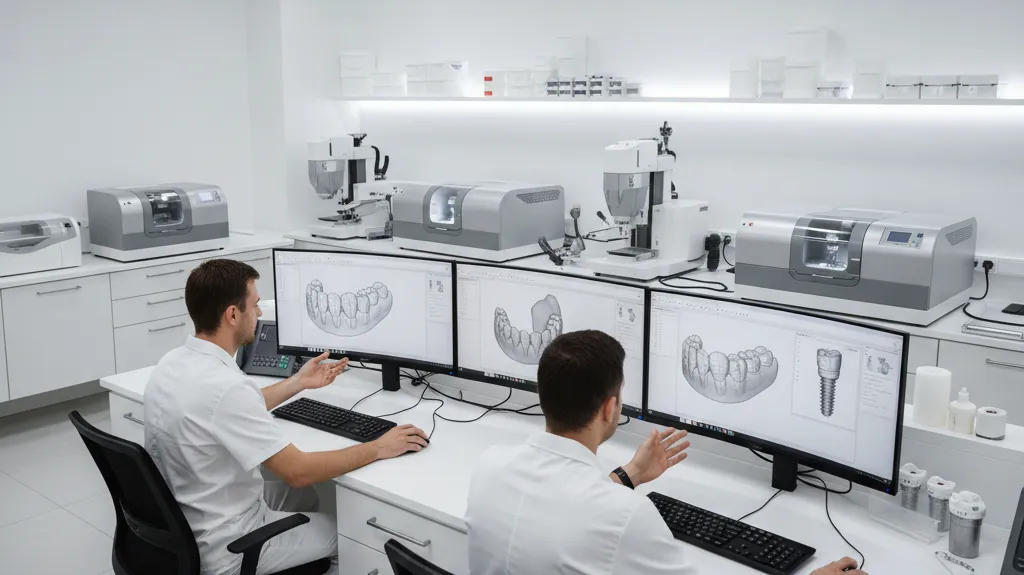
1. Shared digital prescriptions and agreed menus
Instead of free-text lab slips, we set up structured digital prescriptions. For each common clinical situation – say, a posterior single implant on a specific system – you and the lab agree a small menu of options with known fee ranges. Your team selects from that menu in the portal, so the expected components and workflow are clear, and your software can store a reliable estimate for that type of case.
2. Real-time lab pricing and a digital “bill of materials”
With a connected portal, the lab can surface expected components and pricing at the point of case submission – a digital bill of materials: implant platform, abutment type, restorative material, any scan bodies or analogues.
If your treatment plan changes – for example, moving from a cemented crown to a screw‐retained option – the pricing adjusts before you book the patient for the next visit. That gives you a chance to re-confirm the quote and margin instead of discovering the change when the statement arrives.
3. Consistent workflows from scan to fit
When your intraoral scanner and digital workflow are mapped to lab protocols, everyone knows what a “standard” case looks like:
- Agreed scan strategy and required views.
- Standard naming for implant system and platform.
- Default occlusal and contact scheme preferences.
- When a verification jig or additional records are expected.
Consistent digital workflows also have measurable clinical benefits. Recent systematic reviews of digital vs conventional impressions and digital impression patient outcomes report shorter impression and adjustment time and higher patient preference for digital workflows, with overall prosthetic fit broadly comparable when protocols are followed. In practice, that means fewer remakes, fewer unplanned visits and more predictable lab spend.
Analogue vs digital workflow at a glance
| Aspect | Analogue (impressions & models) | Integrated digital workflow |
|---|---|---|
| Impression & design time | Multiple manual steps; longer chairside time. | Fewer steps; shorter impression visits and more efficient design. |
| Remakes & adjustments | Higher chance of misfit from distortions or missing information. | Cleaner data and stored preferences reduce adjustments and remakes. |
| Extra visits | More likely to need additional fitting appointments. | More one-visit fits when inputs are standardised. |
| Margin volatility | Unplanned components and remake bills erode profit. | Structured menus and predictable components keep cases within known fee bands. |
These are general patterns; your own data audit is the best guide to how much analogue versus digital workflows are affecting your margins.
Protecting margins without cutting quality
Many dentists worry that “saving on lab costs” means trading down on materials or using off‐brand components. That is not the aim here. The aim is to remove waste: remakes, repeat scans, unnecessary components, and extra visits that do nothing for the patient.
Reducing remakes and adjustment time
Every remake has a double impact – extra lab charges and extra chair time. With standard digital setups, scan quality is checked while the patient is still in the chair, shade and surface details are captured with photos and structured fields rather than “A2?” on a slip, and your design preferences are stored as templates. The result is fewer surprises and a smoother “one‐visit fit” experience for both you and the patient.
Controlling tooth bridge pricing alongside implants
The same approach helps with bridges. For common indications, NovaDent works with clinicians to set up standard bridge designs with clear fee ranges. You might define, for example:
- Preferred material options for short‐span posterior bridges vs anterior work.
- Default connector dimensions and pontic designs for given spans.
- When metal reinforcement is recommended and how that changes the fee.
Because the lab’s CAD system stores those templates and material choices, your bridge for teeth cost stops zig‐zagging from case to case. You still have clinical freedom to change plan when needed, but those decisions become conscious, documented choices rather than quiet margin leaks.
For an overview of how devices such as implants, abutments and custom prosthetics are regulated in Australia, you can refer to the TGA’s TGA personalised devices guidance.
Digital integration and case quality: more than just cost control
Cost matters, but no dentist wants to protect margins at the expense of long‐term outcomes. The advantage of better digital integration is that it usually improves quality and predictability at the same time as it stabilises fees.
Better planning and communication
With shared digital records, your lab can review CBCT-based plans and digital wax‐ups, design surgical guides and flag restorative challenges (space, angulation, parafunction) before surgery. Fixing problems on‐screen is far cheaper than trying to rescue a poorly positioned fixture later with complex prosthetics.
More consistent restorative outcomes
Because NovaDent restores many implant systems and materials every day, we see which combinations tend to perform well and can support your material and design choices rather than simply “making what’s on the slip”. When those preferences are embedded into your digital prescriptions, you see more consistent emergence profiles, contacts and occlusion across cases – while the workflow, and therefore the cost, stays predictable.
Practical steps to tighten your implant and bridge cost structure with NovaDent Labs
If you are in NSW and already using (or considering) scanners, here is a simple six‐step framework many of our referring dentists follow. We call it the NSW Implant Margin Stability Loop.

- Audit recent cases. Pick around 10 implant and 10 bridge cases. For each, note the original quote, final lab fees, number of visits and any remakes.
- Spot the patterns. Identify where costs drifted – extra components, remakes, material changes or gaps in the lab prescription.
- Standardise your “top 10” cases. Work with the lab to create digital prescription templates and menus for the indications you see most often.
- Connect your scanner and lab portal. Make sure your digital workflow setup captures all the fields the lab needs every time.
- Train the team. Front desk and assistants should know which lab options go with which clinical situations, so quotes and bookings line up with reality.
- Review quarterly. Check whether your average implant and bridge margins are more stable. Adjust menus and protocols as needed.
As a typical pattern, multi-surgery NSW groups that audit 20–40 recent implant and bridge cases often discover more unplanned lab spend and remakes than expected. After six months of using standardised digital prescriptions and menus, many report noticeably lower unplanned lab adjustments per case and fewer remakes, without changing their preferred materials. Your exact results will depend on your starting point, case mix and how consistently new workflows are applied.
NovaDent Labs fabricates implant restorations for dental practices across Australia.
View Implant Services →
Learn About Intraoral Scanners →
Submit a Case →
NovaDent Labs supports NSW practices with case planning, scanner connection and digital workflow support, not just manufacturing. If you would like help mapping your own workflow, contact our team, explore our implant restorations or request a detailed price list for implants and bridges.
FAQ: dental implants cost and tooth bridge pricing questions NSW dentists ask us
How much of an implant case fee usually goes to the lab?
This varies between practices, but in many NSW clinics, the lab and components are the biggest “movable” part of an implant fee. Surgery fees and fixed overheads are relatively stable; it is variation in components, abutments, materials, and remakes that tends to shift margins. Digital integration makes those items more predictable and easier to model when you set or review fees.
Is a bridge for teeth cost always lower than an implant?
Not always. The bridge for teeth cost you pay the lab, which depends on span length, occlusion, materials and whether additional reinforcement is needed. For patients, the bridge for teeth price can look lower initially, but long‐term maintenance and replacement may alter the comparison. From a lab perspective, bringing bridge and implant workflows into the same digital system helps you compare like with like when setting your fees.
How do I discuss dental implants cost with patients when lab prices vary?
Patients do not expect you to predict every small detail, but they do value transparent ranges and clear inclusions. When your lab–clinic workflows are standardised, you can speak confidently about what is included in your implant or bridge fee and which items might change that fee – and how often that actually happens in your own data.
Some dentists also reassure patients that their lab partners use TGA‐aware processes and quality systems, while keeping detailed dollar figures as an internal management tool.
Key takeaways for NSW dentists
- Unstable implant and bridge margins usually come from workflow and communication gaps, not just “expensive labs”.
- Digital prescriptions, agreed menus and real‐time lab pricing make implant and bridge fees easier to predict across similar cases.
- Better integration typically decreases remakes and adjustment time, which protects both profit and patient experience.
- Implant and bridge decisions sit within a regulated medical device environment; aligning with organisations such as the TGA helps you stay on solid ground.
- Partnering with a digital‐focused Sydney lab like NovaDent lets you put these ideas into practice without rebuilding your entire practice software stack.
Disclaimer: This article is for dental professionals in Australia. It does not provide patient‐specific medical, financial or legal advice. Treatment decisions should be based on your own clinical judgment and current guidelines. Results vary; no outcome is guaranteed.
Related Posts
You may also be interested in

How to Find a Premium Dental Lab

Dental Implant Care: The Tooth May Be Artificial, But the Care Is Real
TMJ Splint vs Night Guard: What’s the Difference?

NovaDent Has Arrived.
Previously VTS Dental Labs.
Same team
Same standards
New identity
Visit our new website