
TL;DR
- Patients usually ask for “something permanent” but their suitability depends on bone, abutment teeth, hygiene, habits, and budget.
- Implants often offer the best long term stability and bone preservation when anatomy, health, and finances line up.
- Tooth supported bridges still have a place when adjacent teeth need crowns or implants are contraindicated.
- Well made removable dentures (with or without implants) remain essential for multi unit or full arch cases where cost is a major factor.
- Clear explanations of options and realistic pricing ranges help patients choose a plan they can commit to and maintain.
Why permanent replacement matters for your patients
Every clinician knows the patient who arrives saying, “I just want this fixed properly once.” When they talk about “permanent teeth replacement,” they’re not asking for a miracle; they want to chew without worry, smile without thinking, and not feel that something might fall out mid sentence.
Missing teeth change far more than aesthetics. They alter occlusion, reduce chewing efficiency, affect speech, and accelerate local bone loss. Over time, that can complicate future restorative work and make stable prostheses harder to deliver. For additional patient friendly explanations, see missing teeth replacement options.
For that reason, decisions about long term replacement are best framed as a balance of biology, biomechanics, maintenance, and cost, rather than a single “best” treatment. The goal is the right option for this patient in this mouth, not a one size promise.
Overview of permanent teeth replacement options
In day to day practice, most permanent teeth replacement options fall into three broad categories:
- Implants – single implants, implant bridges, or full arch solutions (e.g. fixed hybrids or All on 4).
- Fixed dental bridges – conventional tooth supported or resin bonded bridges.
- Dentures – removable partials, full dentures, and implant retained overdentures.
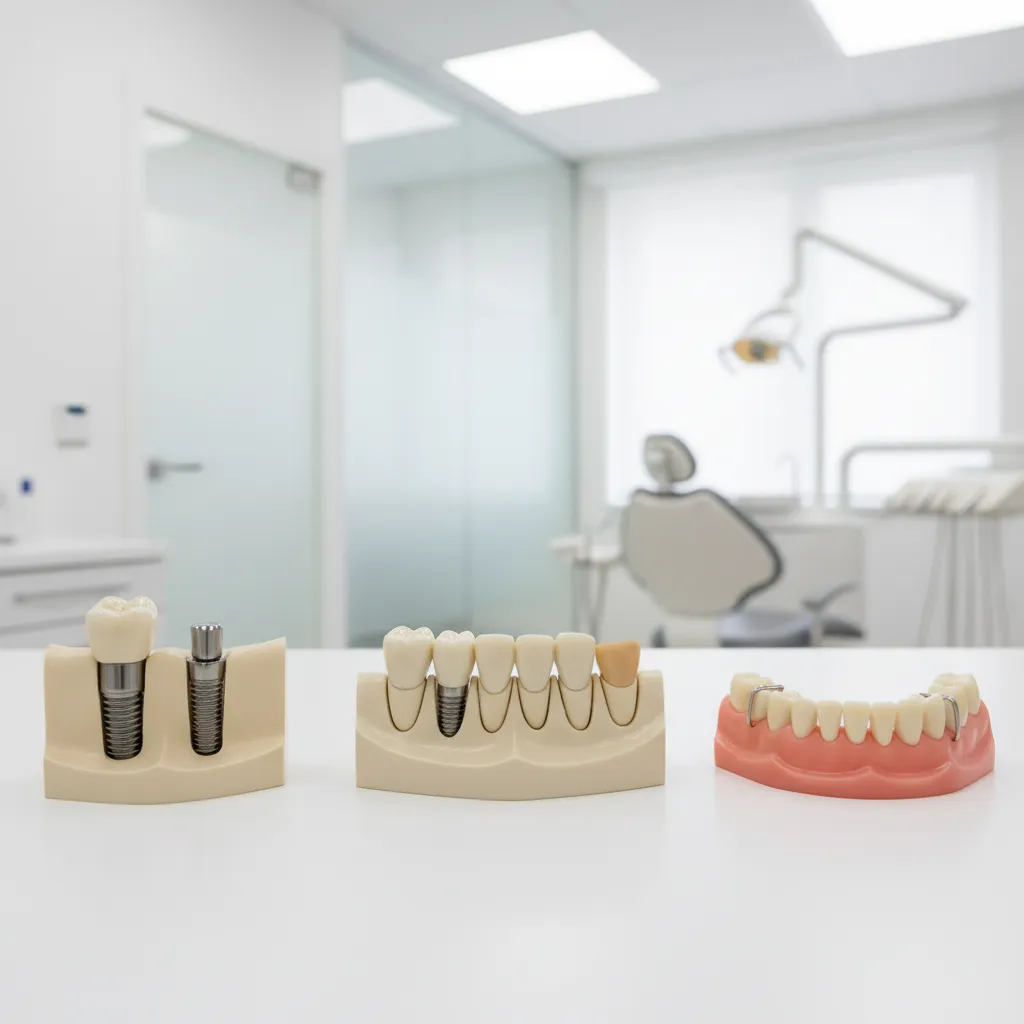
Clinically, most permanent teeth replacement options centre on implants, fixed bridges, and removable dentures, each with distinct biological and financial profiles.
Other options such as autotransplantation or orthodontic space closure exist, but in a lab driven restorative workflow, implants, bridges, and dentures remain the workhorses. Less common approaches such as tooth autotransplantation can also be considered in carefully selected cases.
The rest of this article unpacks when each option tends to work best, how long it usually lasts, and how to speak with patients who are naturally focused on durability and budget.
Dental implants: indications, workflow, and pricing benchmarks
For many clinicians, implants are the default answer when a healthy adult asks for a long term solution for a single missing tooth. Survival data backs that instinct: multiple reviews report five year survival rates in the mid to high 90s for well planned implant restorations, as summarised in an implant survival evidence review.
When implants fit the brief
- Single missing tooth with adequate bone and healthy adjacent teeth.
- Posterior gaps where additional abutment preparation would remove significant tooth structure.
- Intact periodontal support and manageable occlusal forces (or the ability to manage them).
- Patients willing to commit to hygiene and reviews.
Implants also shine in full arch cases where conventional dentures are unstable. Fixed implant bridges or hybrid prostheses can restore function and confidence for edentulous patients who have struggled with lower denture retention.
What to say about implant pricing
Patients rarely ask, “What is the biological cost of this option?” They ask for the permanent teeth replacement price. In Australia, many practices quote in the range of roughly $3,000–$6,500 per tooth for a single implant including the final crown, with significant variation by region, system, and pre implant procedures. Australian dental implant cost ranges illustrate how widely fees can vary.
Compared with bridges, this can feel high, but you can highlight that well planned implants usually avoid preparation of adjacent teeth and support local bone volume over time.
Workflow notes for your lab
- Digital impressions: IOS files (STL/PLY) integrated directly into CAD/CAM workflows reduce remake rates and chairside adjustments. NovaDent accepts all major scanner outputs.
- Restorative design: Clear instructions on emergence profile, material choice (e.g. monolithic zirconia vs layered), and opposing dentition help your lab design restorations that fit both function and aesthetics.
- Implant verification: For multi unit cases, verification jigs and try ins are worth the extra visit to avoid stress in the final prosthesis.
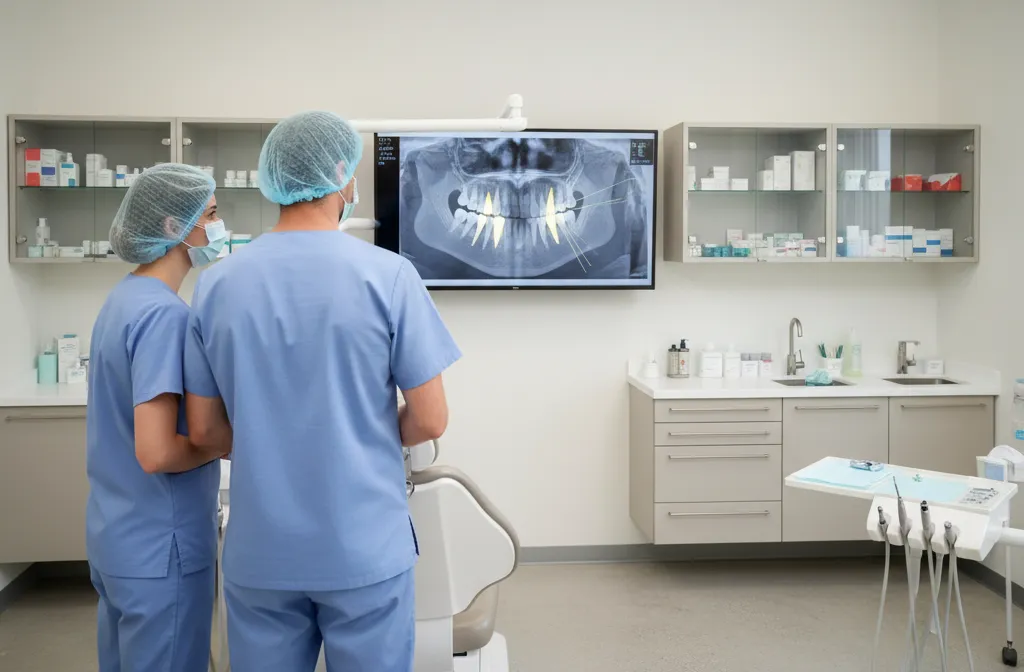
Digital planning and close communication with your lab help permanent teeth replacement options with implants translate predictably to the mouth.
On paper, implants are hardware. In the mouth, they’re long term biological relationships that depend on case selection, hygiene, and maintenance.
Fixed dental bridges: when a traditional solution is right
Fixed bridges are still very much alive. For some patients, a bridge is the more sensible “permanent” choice, especially where abutment teeth already need full coverage restorations or implants are contraindicated.
Conventional tooth supported bridges
A three unit bridge can restore a single missing tooth with predictable function. Survival data for short span fixed dental prostheses is generally favourable, though abutment health and endodontic status are key, as highlighted in a fixed dental prosthesis survival study.
From a cost perspective, Australian data often places bridges at roughly $1,000–$1,800 per involved tooth, depending on material and complexity, with examples in this dental bridge cost guide. Patients hear that as “cheaper than implants,” but you can gently flag that the biological price includes preparation of neighbouring teeth and possible endodontic treatment over time.
Resin bonded bridges
Resin bonded (resin retained) bridges can be helpful for younger patients where implant placement needs to be delayed or bone growth is incomplete. Survival rates are lower than for conventional bridges, but conservative preparation and careful occlusion can still yield solid medium term service; resin retained bridge overviews are useful refreshers on indications and design.
Lab considerations for bridges
- Provide clear guidance on connector dimensions, especially in high load zones.
- Discuss material selection (e.g. PFM, full contour zirconia, lithium disilicate in aesthetic zones).
- Share periodontal status and mobility so the lab can design with realistic expectations for abutment support.
Internal communication with your lab on these details can be the difference between a bridge that looks good on delivery and one that still performs well ten years later.
Removable and implant retained dentures
When multiple teeth or full arches are involved, dentures remain the backbone of many treatment plans. For some patients, they are the only financially reachable solution; for others, they serve as an interim step toward a fixed implant solution.
Partial dentures
Removable partial dentures are indicated where multiple spaces exist or strategic abutment teeth are missing. They can often be improved dramatically with considered design: RPI concepts, careful clasping, and broad coverage for stability; see this removable partial denture design overview for a quick refresher.
Complete dentures
Upper complete dentures often achieve tolerable retention; lower dentures are more challenging. This is where two to four implants for an overdenture can be life changing in terms of function, without the cost of a full fixed bridge. Patient facing resources such as this dentures overview can reinforce your explanations.
Implant retained overdentures
- Improve stability, retention, and chewing efficiency for edentulous patients.
- Can be staged financially: implants first, then upgraded prosthesis later.
- Still removable for hygiene, which many older patients and carers appreciate.
For medically compromised or older patients, an overdenture may offer the best balance between surgical load, hygiene access, and day to day comfort.
Talking about permanent teeth replacement price
Many patients arrive with a fixed idea: “Implants are too expensive” or “Dentures are the cheap option.” A quick way to reframe the discussion is to compare lifetime value and maintenance, not just the upfront invoice.

Clear, calm conversations about permanent teeth replacement options, pricing, and staging help patients choose realistic plans they can maintain.
How much does permanent teeth replacement cost in Australia?
Broadly, single tooth implants (including the crown) often fall in the mid four figure range, short span bridges somewhat lower per unit, and partial or complete dentures lower again per arch. Geographic location, case complexity, materials, and required adjunctive procedures (such as grafting) all shift these ranges. Rather than quoting exact figures too early, many clinicians find it safer to give ballpark brackets, explain what drives the variation, and then confirm itemised estimates once full records and lab input are available.
When discussing permanent teeth replacement options, you might:
- Give honest ballpark ranges (e.g. “Implants tend to sit in the mid four figure range per tooth, bridges somewhat lower, dentures lower again”), while stressing that a personalised quote comes after full assessment.
- Explain that remakes, relines, and repairs add to the long term cost of removable options.
- Highlight that good hygiene and reviews are the best “insurance policy” for any prosthesis.
Case vignette: A 58 year old patient missing two lower molars wanted “the most permanent option” but was unsure about cost. You outlined a staged plan of a partial denture now, with the option to convert to two implants later once finances allowed; with clear timelines and indicative fees, the patient chose to start with the partial denture and booked a review in 12 months to reassess for implants.
Longevity & maintenance expectations
No prosthesis is truly “set and forget”. Framing longevity in realistic service life ranges, with maintenance built in, can help patients commit to appropriate reviews and hygiene.
- Single implants and implant bridges: fixtures can often function for 10–20+ years in healthy, compliant patients, but crowns or bridges may need replacement or repair after a decade or so, especially in high load cases.
- Tooth supported bridges: 10–15 years is common in well selected cases, but biological complications around abutments (caries, endodontic issues, periodontal breakdown) frequently dictate actual lifespan.
- Partial dentures: expect 5–10 years before major redesign or remake as remaining teeth drift, wear, or are lost; interim relines and clasp adjustments are routine.
- Complete dentures and overdentures: 5–10 years before full remake is typical, with relines, occlusal equilibration, and replacement of attachment inserts (for overdentures) at regular intervals.
Regular 6–12‑monthly reviews, radiographs as indicated, and early intervention on wear or minor fractures go a long way toward extending these service life ranges. Patients appreciate explicit explanations that fees for maintenance, relines, and component changes are part of protecting their original investment.
Across all modalities, key risks include peri implantitis and screw or prosthetic fracture around implants, caries and endodontic complications on bridge abutments, and sore spots, instability, and progressive ridge resorption with removable prostheses. Framing these as manageable with hygiene instruction, regular recalls, occlusal review, and timely relines, component replacements, or repairs helps patients understand that “permanent” really means long term, maintained dentistry rather than a one off solution.
A simple chairside framework for choosing options
When you’re juggling schedules and emergencies, a quick mental checklist helps. When patients ask, “What are my permanent teeth replacement options?”, a simple way to frame the discussion is to walk through a few common scenarios and then adapt them to their mouth and budget:
| Scenario | Often considered first | Alternatives to discuss |
|---|---|---|
| Single missing tooth, healthy neighbours, good bone | Single implant crown | Conventional bridge, resin bonded bridge (younger patients) |
| Short span edentulous area, neighbours need crowns | Tooth supported bridge | Two implants with implant bridge, partial denture |
| Multiple missing teeth, limited budget | Removable partial denture | Staged plan toward implants, overdenture later |
| Full lower arch, poor denture tolerance | Implant retained overdenture (2–4 implants) | Fully fixed implant bridge if health and finances allow |
This isn’t a protocol, just a fast way to structure the conversation and then fine tune based on medical history, expectations, parafunction, and anatomy.
How NovaDent Labs supports your restorative cases
A good lab partner helps your treatment plans translate reliably into the mouth. At NovaDent Labs in Sydney, our clinicians and technicians work together on:
- Implant restorations – from single units to full arch fixed prostheses, compatible with major systems and digital workflows. implant restorations.
- Crowns and bridges – including zirconia, lithium disilicate, and PFM options for both tooth and implant supported work. fixed prosthetics.
- Dentures and overdentures – precision acrylic and metal frameworks, plus implant bar and locator solutions. removable prosthetics.
- Case planning support – material selection, design suggestions, and help interpreting your scans and photos.
If you’d like a clear schedule of lab fees to support your own discussions about permanent teeth replacement price, you can request our current fee guide at any time.
Related Posts
You may also be interested in

How to Find a Premium Dental Lab

Dental Implant Care: The Tooth May Be Artificial, But the Care Is Real
TMJ Splint vs Night Guard: What’s the Difference?

NovaDent Has Arrived.
Previously VTS Dental Labs.
Same team
Same standards
New identity
Visit our new website