
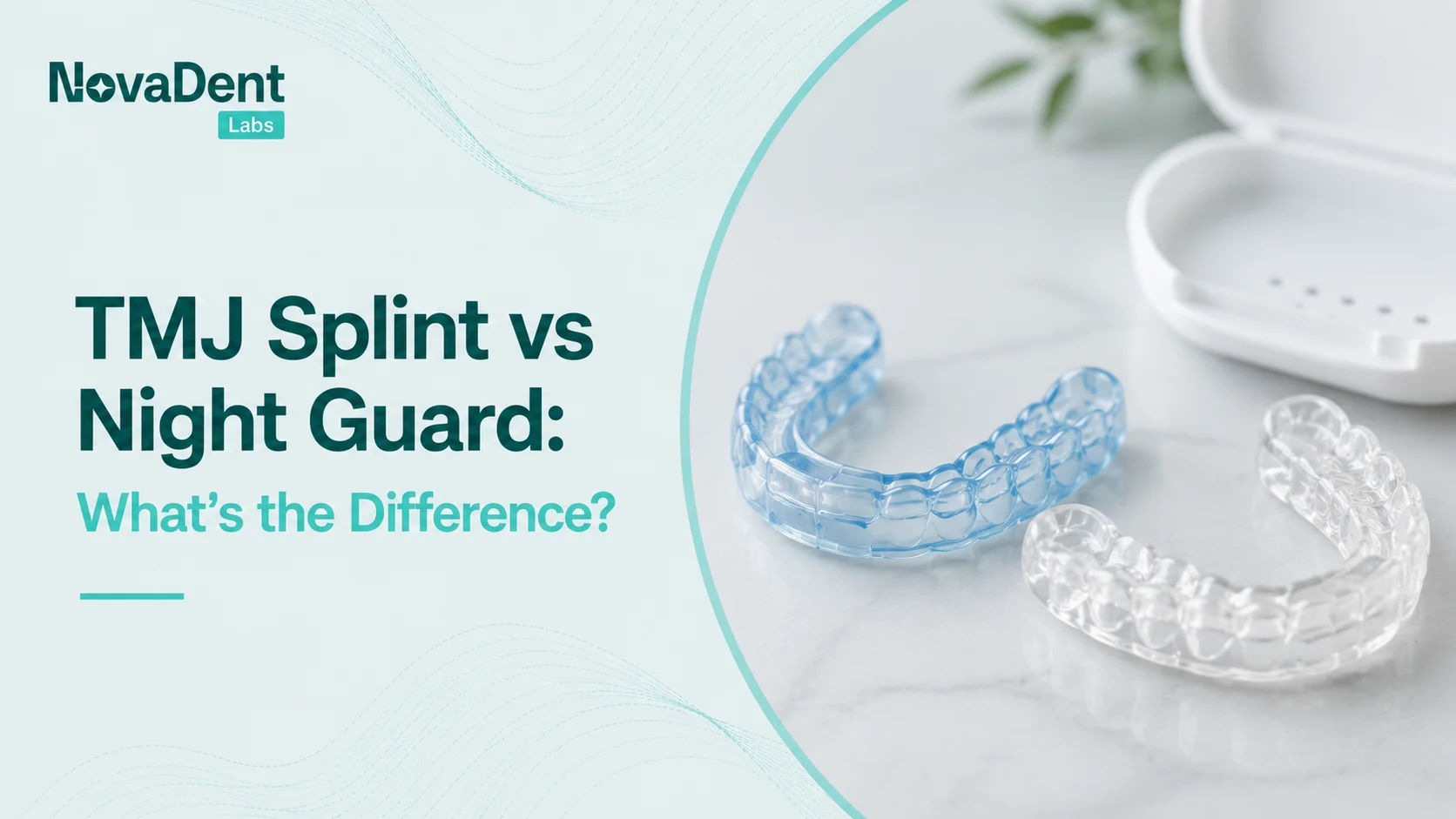
Many dentists hear a version of this in the chair: “My last dentist gave me a night guard. The TMJ specialist says I need a splint, isn't that the same thing?” Online, terms like mouthguard, occlusal splint and orthotic are often used interchangeably. Clinically, the distinction is simpler, even when a patient asks about a “tmj splint vs night guard”: what diagnosis are you treating, and what exactly do you want the appliance to change?
This guide gives a practical comparison of TMJ splints and night guards for Australian dentists, focusing on indications, design intent and the lab details that keep your next appliance fit appointment short.
Epidemiological reviews suggest that TMD affects around one third of adults and bruxism about one in five, so many recall patients may benefit from an appropriate occlusal appliance.
This article is for dental professionals. It provides general information only and is not a substitute for your own clinical training, assessment or local guidelines.
A clear, chairside explanation of TMJ splint vs night guard helps align appliance choice with diagnosis.
TL;DR
- A TMJ splint (occlusal splint/orthotic) is a therapeutic appliance designed to influence joint loading, muscular activity and/or mandibular position.
- A night guard (occlusal guard) is primarily a protective appliance to limit tooth wear and parafunctional loading from bruxism.
- The “right” device depends on a clear diagnosis: simple nocturnal bruxism vs temporomandibular disorder (TMD) with joint or myofascial pain.
- From a lab perspective, precision records and clear prescription notes matter far more than what the appliance is called.
TMJ splint vs night guard: quick comparison
The terminology is famously “loose” in both the literature and everyday practice. Some sources use splint, occlusal guard and night guard almost interchangeably, while others distinguish them by diagnosis, design intent and occlusal scheme

Both TMJ splints and night guards are clear occlusal appliances, but their design intent and indications differ.
| Feature | TMJ splint | Night guard |
|---|---|---|
| Primary goal | Therapeutic: modify joint loading, muscle activity and/or mandibular position | Protective: reduce tooth wear, chipping and overloading from bruxism |
| Typical indication | TMD with joint or myofascial pain, limited opening, clicking, locking | Nocturnal bruxism with minimal joint symptoms, fractured/worn dentition |
| Occlusal scheme | Planned occlusion (e.g. flat plane centric, canine guidance, repositioning) | Often simpler coverage; may not be fully articulated or equilibrated |
| Design variants | Stabilization (Michigan) splint, anterior repositioning splint, anterior bite plane | Soft guard, hard guard, dual laminate guard |
| Wear schedule | Often night time; some protocols include daytime wear | Mainly night time wear |
| Therapeutic ambition | Part of multi modal TMD care aimed at symptom relief and functional change | Not designed to treat the joint directly; aims to mitigate parafunction |
When patients ask, “What is the difference between a TMJ splint and a night guard?”, the shortest honest answer is: the diagnosis and the design intent, not just the material.
What is a TMJ splint?
“TMJ splint” usually refers to a hard, full coverage occlusal splint prescribed for TMD management rather than simple bruxism protection. Common examples include maxillary flat plane stabilization splints and anterior repositioning splints. Clinical studies suggest these appliances can reduce pain and improve function in selected TMD or bruxism patients, especially when splint therapy is combined with self management, medication and physiotherapy
Therapeutic goals
- Reduce adverse loading on the temporomandibular joints and masticatory muscles.
- Provide a stable, repeatable occlusal position (often centric relation or a defined therapeutic position).
- Optimise occlusal contacts and guidance as a reversible way to test joint and muscle response before any irreversible occlusal change.
Present splints as a reversible component of conservative TMD care that aims for symptom relief, not as a stand alone cure or automatic justification for irreversible occlusal changes.
Common TMJ splint designs
- Stabilization (Michigan) splint – flat plane, full coverage splint with even centric contacts and canine guided or light group function excursions.
- Anterior repositioning splint – guides the mandible slightly forward to manage disc displacement in carefully selected cases.
- Anterior bite plane – contacts anterior teeth only; used short term for acute muscle pain or headaches.
A TMJ splint is a reversible experiment in changing how the jaw joints and muscles work together so records, occlusal planning and follow up all matter.
What is a night guard?
A night guard (occlusal guard) is usually prescribed for sleep bruxism without significant joint pathology. Its main job is to separate the arches, spread occlusal load and reduce mechanical wear on teeth and restorations, without intentionally repositioning the mandible or establishing a complex occlusal scheme. It may reduce muscle activity in some patients, but its primary value is protection rather than targeted TMD therapy.
Common night guard types
- Soft guard – flexible material (often EVA). Comfortable, but may encourage chewing in some patients.
- Hard guard – rigid acrylic or milled resin with good long term fit and wear resistance.
- Dual laminate guard – soft inner layer for comfort with a hard outer shell for durability.
Patients often arrive having tried chemist “boil and bite” guards. These may be a short term stopgap but are rarely equilibrated, can impinge on tissues or concentrate forces, and are usually less comfortable and predictable than custom guards. Many practices still fabricate guards from alginate impressions on hand articulated models, but guards designed on precise digital articulation from intraoral scans and a clear written prescription tend to seat with fewer adjustments and give better long term comfort.
Night guard vs TMJ splint: when to choose which?
Clinically, the question “night guard vs TMJ splint” only makes sense after a structured history and examination. Broadly:
- Mostly tooth wear, chipped cusps, minimal joint pain – a well designed night guard is often the most appropriate starting point.
- Joint pain, limited opening, clicking/locking, deviation, chronic headaches – these patients usually warrant a thorough TMD work up and, where indicated, a TMJ focused splint as part of multi modal care
- Red flags (sudden open lock, trauma, suspected inflammatory arthritis, neuropathic pain) prompt referral to an orofacial pain specialist or maxillofacial surgeon rather than “just a guard”
Three step decision framework
- Step 1 – Diagnose: distinguish simple bruxism from TMD and screen for red flags (locking, trauma, systemic disease, neuropathic features).
- Step 2 – Match intent: choose a therapeutic TMJ splint for TMD, a protective night guard for uncomplicated bruxism, or refer when pathology is beyond your scope.
- Step 3 – Specify design: document records, desired occlusal scheme, material choice and a review plan so your lab can build to your intent.

Discussing TMJ splint vs night guard options in the context of a clear diagnosis supports shared decision making.
Evidence is mixed: some trials show benefit from stabilization splints for TMD pain, while others find little difference from other conservative measures. What is consistent is that diagnosis, patient education and expectations matter more than appliance branding.
Clinical scenarios: splint or guard?
Case 1 – uncomplicated sleep bruxism. A 35 year old has generalised enamel wear and partner reported grinding, but no joint symptoms or functional limitation. A hard maxillary night guard with full arch coverage, even centric contacts and smooth excursions is usually sufficient; you can reassess if joint or muscle symptoms develop.
Case 2 – mixed bruxism and myofascial TMD. A 42 year old reports morning stiffness, temple headaches and occasional joint sounds, with muscle tenderness and mild deviation on opening but no locking. After ruling out red flags, many clinicians start with a maxillary stabilization splint in a reproducible centric relation position, combined with physiotherapy and behavioural strategies rather than a basic guard.
Case 3 – complex TMD with red flags. A 55 year old with recent facial trauma has progressive limitation of opening, unilateral preauricular pain at rest and episodes of open lock features suggestive of intra articular pathology or fracture. Urgent imaging and referral to an orofacial pain specialist or maxillofacial surgeon are indicated; a generic night guard risks delaying appropriate care.
Design and lab considerations for predictable outcomes
Whether you prescribe a TMJ splint or a night guard, the lab can only build what you specify. Clear records and instructions make it far more likely that the appliance feels “right” on first fit and needs minimal adjustment.
Records that make a difference
- Accurate impressions or scans – full coverage of occlusal surfaces; digital scans suit CAD/CAM splints.
- Interocclusal record – centric relation or a defined therapeutic position for TMJ focused splints.
- Articulation details – desired guidance and disclusion; note any posterior interferences to remove on the splint.
- Clear indication – for example “protective night guard for bruxism” vs “stabilization splint for myofascial TMD”.
Material and design choices
For most TMD focused splints, a milled hard acrylic or high strength resin with full occlusal coverage and adjusted guidance provides stability, polishability and easy adjustment. For straightforward bruxism cases, a hard or dual laminate guard is usually more durable than a purely soft guard, especially in heavy grinders
If you use digital impressions, see our intraoral scanner connection guide. Our occlusal splint guide gives a practical summary of material options, occlusal schemes and workflows.
In our digital splint workflow at NovaDent, cases sent with accurate centric relation records and clear prescriptions typically seat with only minor occlusal refinements and fewer review visits than hand articulated cases. Standardising records and designs with the lab can save chairtime across your TMD and bruxism caseload.
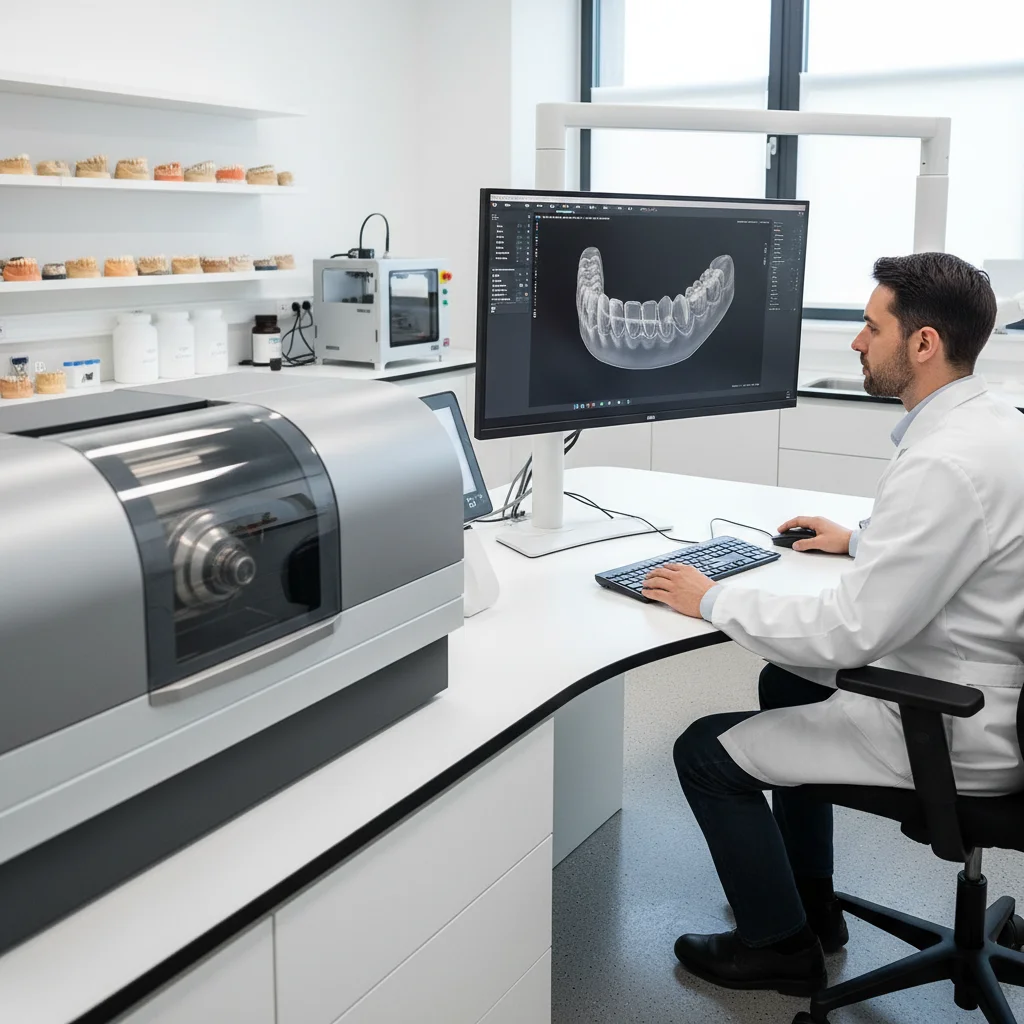
Digital workflows for TMJ splints and night guards help the lab deliver precise, predictable appliances.
Common prescription mistakes (and how to avoid them)
- Vague diagnosis and appliance type. Instead of just writing “TMJ splint”, include the working diagnosis, key symptoms and whether you want a protective guard, stabilization splint or repositioning appliance.
- No jaw relation record for therapeutic cases. For any TMJ focused splint, always supply a centric relation or agreed therapeutic bite so articulation reflects your intended joint position.
- Partial or too thin designs in heavy bruxers. Reserve anterior only or very thin appliances for short term use; full-arch coverage with adequate thickness is safer for long term protection.
- Non specific instructions and no review plan. Specify guidance (canine vs group function), note any interferences to remove and set expectations for follow up visits, especially in active TMD cases.
How NovaDent Labs supports TMJ splints and night guards
At NovaDent Labs, we work with general dentists and specialists across Australia to design both therapeutic TMJ splints and protective night guards. Using CAD/CAM workflows, we build appliances from intraoral scans or high quality impressions and digitally verify contacts and excursions to help reduce adjustment time at fit.
For complex TMD cases, we can review records and discuss options such as stabilization splints, anterior repositioning splints or the SOMA appliance, which NovaDent Labs manufactures exclusively with Dr Joseph Da Cruz (SOMA appliance). Use our contact page or price list request form to plan your next occlusal appliance case with us.
FAQs
Is a TMJ splint just a more expensive night guard?
No. A TMJ splint is usually prescribed for a specific TMD diagnosis and fabricated on detailed records to influence joint loading and muscle activity. A basic night guard mainly protects teeth from bruxism related wear and may not change joint mechanics predictably. That is why TMJ splints generally involve more records, adjustment and follow up.
Can a simple night guard worsen TMD symptoms?
It can in some patients. Problems arise when a guard is poorly fitted, offers only partial coverage or encourages posterior only contact that alters the bite. Full coverage, well equilibrated designs plus review and timely referral are safer than repeatedly remaking a similar, poorly adjusted guard.
Can over the counter night guards replace a custom TMJ splint?
Over the counter or “boil and bite” guards may offer short‑term protection from tooth wear, but they are not made to a therapeutic jaw position and cannot be equilibrated precisely. They should be viewed as temporary protection, not a replacement for a custom TMJ splint prescribed for a specific diagnosis and reviewed over time. If you suspect true TMD, a custom appliance or referral is safer.
Which is “best” for headaches: night guard or TMJ splint?
There is no single best appliance for headaches. Some patients with muscle related or tension type pain respond well to a stabilization splint; others do just as well with a protective night guard or non appliance care. The key is to identify the main pain drivers and align the appliance, or decision not to use one, with that diagnosis, then reassess as symptoms change.
Related Posts
You may also be interested in

How to Find a Premium Dental Lab

Dental Implant Care: The Tooth May Be Artificial, But the Care Is Real
How to Clean a Mouth Guard Properly Without Damaging It

NovaDent Has Arrived.
Previously VTS Dental Labs.
Same team
Same standards
New identity
Visit our new website