
TL;DR
- MUAs (multi unit abutments) create a common prosthetic platform for screw retained bridges and full arch restorations.
- They correct implant angulation, move the connection coronally away from bone, and help control tissue depth and cleansability.
- In All on 4 cases, the right MUA selection can be the difference between a quick insertion and hours of grinding.
- Clear lab prescriptions, correct cuff heights, and compatible scan bodies keep your full arch workflow predictable.
Ask any clinician who restores full arch implants, and they’ll tell you: the MUA is a tiny part with an outsized impact. These components set the stage for prosthetic fit, screw channel access, cleansability and long term tissue health. When selection is rushed, chairside time stretches out, occlusion suffers and patients end up back in your book for yet another “adjustment” visit.
This guide is written for implant dentists, prosthodontists and oral surgeons who want a practical, lab focused view of when to use MUAs, how they differ from conventional abutments, and what information your lab actually needs. We’ll walk through design features, benefits and real world applications from short span screw retained bridges through to immediate load All on 4 cases so your next full arch feels pleasantly uneventful.
If you’re looking to standardise your implant restorative workflow, you may also find our articles on implant restorations and our full mouth rehabilitation guide helpful.
Implant dentists and lab technicians often plan multi unit abutment cases together using 3D full arch simulations.
What Is a Multi Unit Abutment?
Where it sits in the “implant stack”
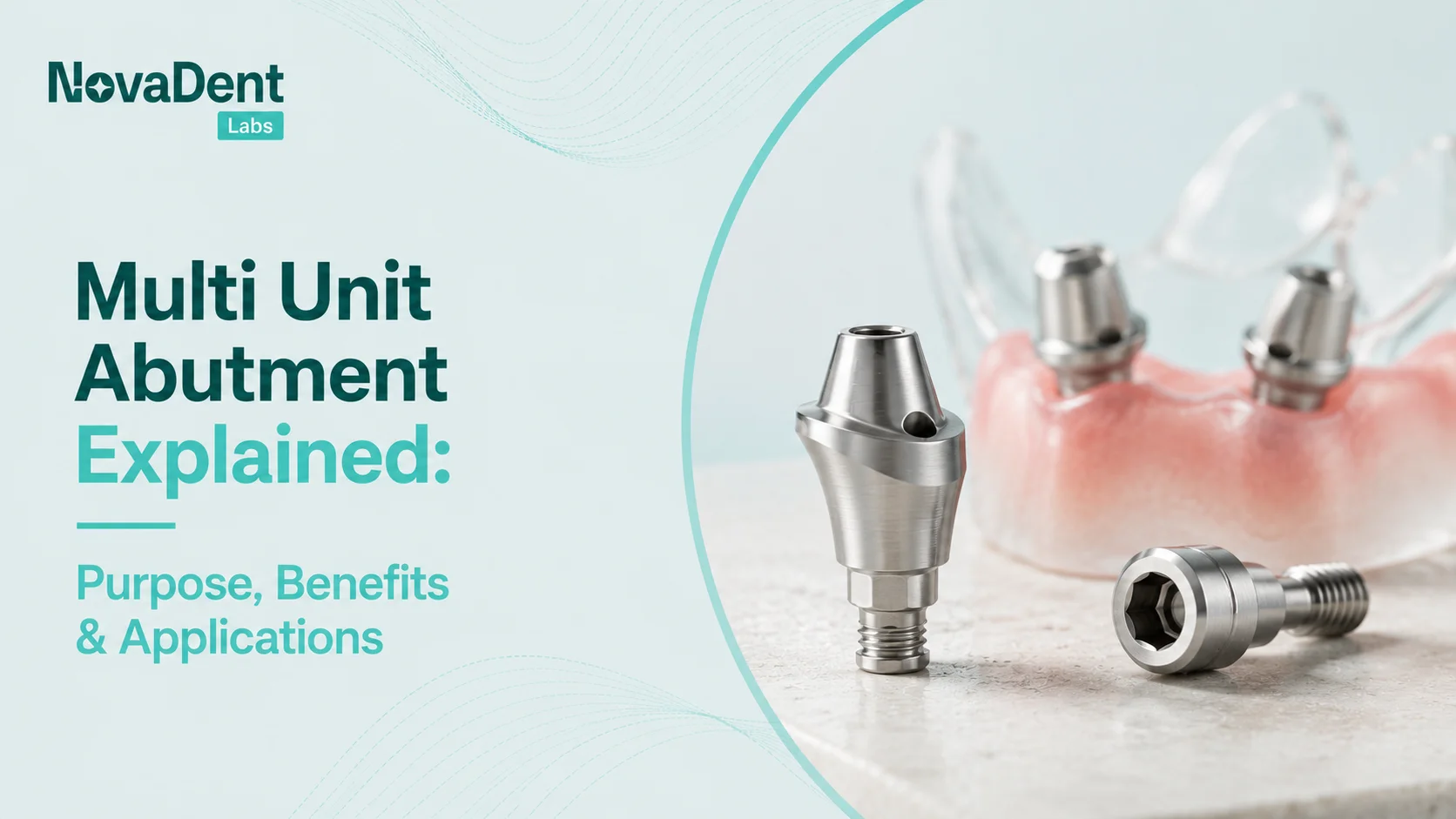
In simple terms, a multi unit abutment is a prosthetic interface that sits on top of a bone level implant and below a screw retained restoration. Instead of connecting your bridge or full arch directly to the implant platform, you connect to the MUA. The “stack” becomes:
- Osseointegrated implant (fixture)
- MUA (straight or angulated, various cuff heights)
- Titanium or zirconia framework, bridge, or full arch
- Occlusal screws through the prosthesis into the MUA

A simple jaw model helps patients visualise how multi unit abutments sit between the implant fixture and a screw retained bridge.
This separation means that, in many systems, you can remove or replace the prosthesis without disturbing the implant interface itself, and in some workflows even convert between provisional and final without removing the MUAs.
Straight vs angulated MUAs
Most implant systems offer straight MUAs (0°) and angulated versions (typically 17°, 30° and sometimes 45°). Angulated options are especially valuable in the maxilla and in posterior segments where anatomical structures dictate implant tilt. By using an angulated MUA, you can “upright” the prosthetic platform so screw channels emerge in functionally and aesthetically acceptable locations.
A quick rule of thumb many clinicians use: place the implant where the bone allows, then use the MUA to position the restorative platform where the prosthesis needs to be not the other way round.
Why MUAs Matter in Full Arch and Complex Cases
Biomechanics and load distribution
In full arch frameworks, MUAs help create a co-planar restorative platform across implants placed at different levels or angulations. This simplifies passive, screw retained framework design and supports more even load distribution, especially when combined with CAD/CAM milling and verification jigs.
That restorative “flattening” effect is a key reason MUAs are integral to protocols such as the All on 4 treatment concept, which relies on angled posterior implants and standardised prosthetic interfaces.
Soft tissue, cleansability, and screw access
MUAs help you position the prosthetic connection at an appropriate distance from the bone crest, supporting soft tissue stability and easier hygiene access. The correct cuff height can reduce food traps and make interdental cleaning more realistic for patients compared with a restoration that “dives” subgingivally.
They also keep screw access holes where you can actually reach them, rather than emerging on the buccal or incisal aspect of key anterior teeth.
“MUAs are the small hinge that swings the big door of full arch success, gets them right and everything downstream gets easier.”
Indications & Applications for MUAs
1. Short span screw retained bridges
While many clinicians associate MUAs with full-arch work, they are just as useful in shorter spans:
- Two to four unit screw retained bridges where implants are not perfectly parallel
- Sites with limited interocclusal space, where cement clean up would be challenging
- Patients at higher risk of peri-implant disease, where retrievability is a priority
Using MUAs in these situations allows a consistent restorative workflow that mirrors your full arch protocol, which can make your crown and bridge and implant teams work more in sync.
2. All on 4 multi unit abutment cases
In the classic All on 4 configuration, two anterior implants are placed axially and two posterior implants are tilted to maximise anteroposterior spread and avoid anatomical structures. MUAs are then placed on each implant to correct angulation and standardise the prosthetic platform.
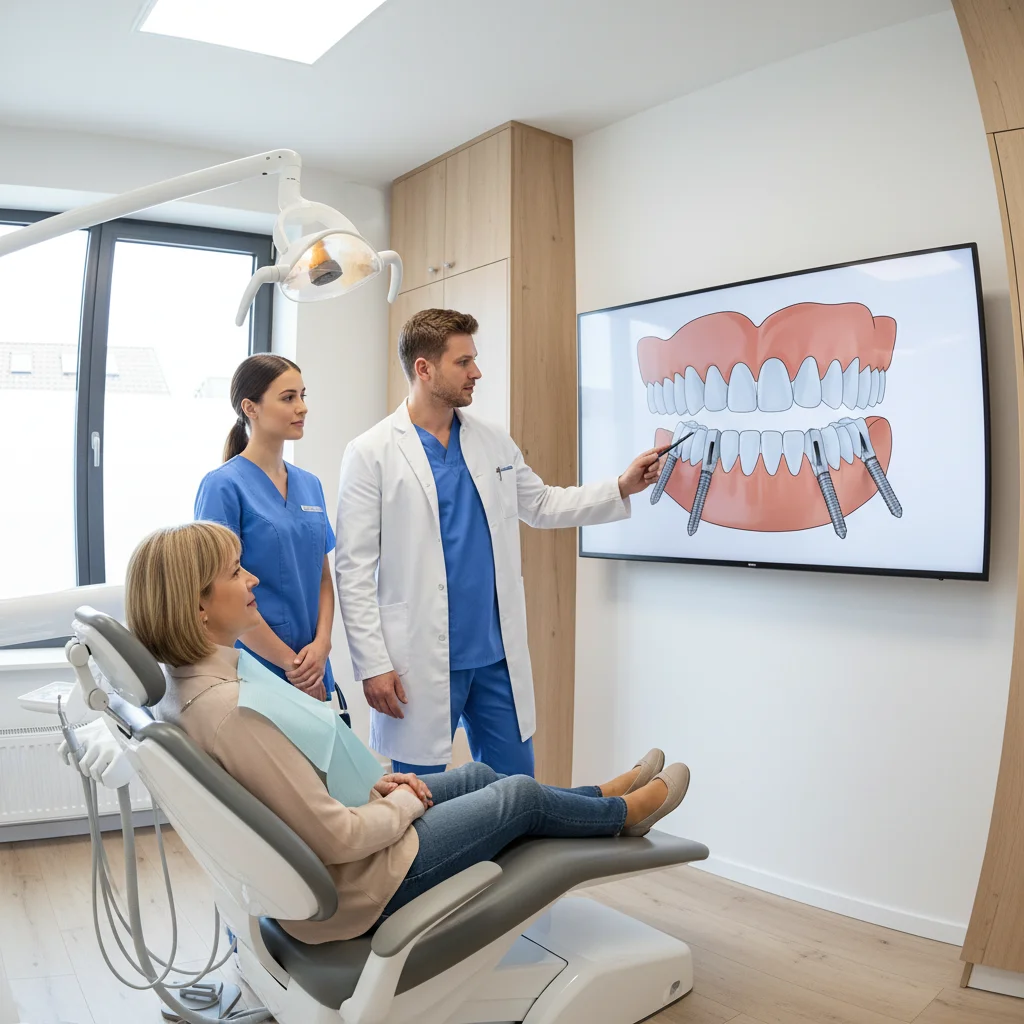
All on 4 style cases rely on careful planning of implant angulation and multi unit abutment selection to achieve a predictable full arch result.
Key roles of MUAs in All on 4 cases include:
- Providing a common prosthetic interface across axial and tilted implants
- Allowing a passive, one piece screw retained framework
- Facilitating immediate load provisionals when primary stability and systemic factors permit
If your practice is building a dedicated All on 4 workflow, consider standardising on a small range of MUA heights and angulations for each implant system you use, and documenting this in a shared protocol with your lab.
3. Converting existing dentures to fixed
In edentulous patients with a well fitting denture, MUAs are often used during conversion to an immediate fixed bridge. The denture can be indexed, sectioned and picked up on temporary cylinders connected to the MUAs, reducing chairside time at the surgical visit. Your lab then refines or remakes the provisional and later fabricates the definitive framework based on the same MUA positions.
Key Design Features to Consider
Implant connection and platform
Not all MUAs are cross compatible, even within the same manufacturer family. You’ll need to match:
- Implant connection type (internal hex, conical, etc.)
- Platform diameter (narrow, regular, wide)
- System specific prosthetic screws and drivers
When sending a case to the lab, include the exact implant line and platform size on your prescription, or refer to your lab’s implant restoration services page if you use multiple systems.
Cuff height and soft tissue thickness
Correct cuff height selection is one of the most common pain points. Too short, and the prosthesis or cement line ends up below tissue, increasing inflammation risk. Too tall, and you compromise emergence profile and aesthetics.
As a starting framework many clinicians aim to position the prosthetic connection a few millimetres above the bone crest, with enough vertical tissue thickness to support a stable mucosal seal. If you’re unsure, photos with a periodontal probe or soft tissue measurements marked on your lab sheet give your lab a chance to sanity check your choices.
Angulation and restorative space
Angulated MUAs help you redirect screw channels into more favourable occlusal or palatal positions while respecting restorative space. Over angulation may thin the prosthesis or bring the screw head too close to the labial surface.
This is where pre-operative planning often in collaboration with your lab, using CBCT and digital wax ups saves headaches. Organisations such as the Academy of Osseointegration host extensive education on evidence based implant planning and restoration.
Clinical Workflow: From Surgery to Final Prosthesis
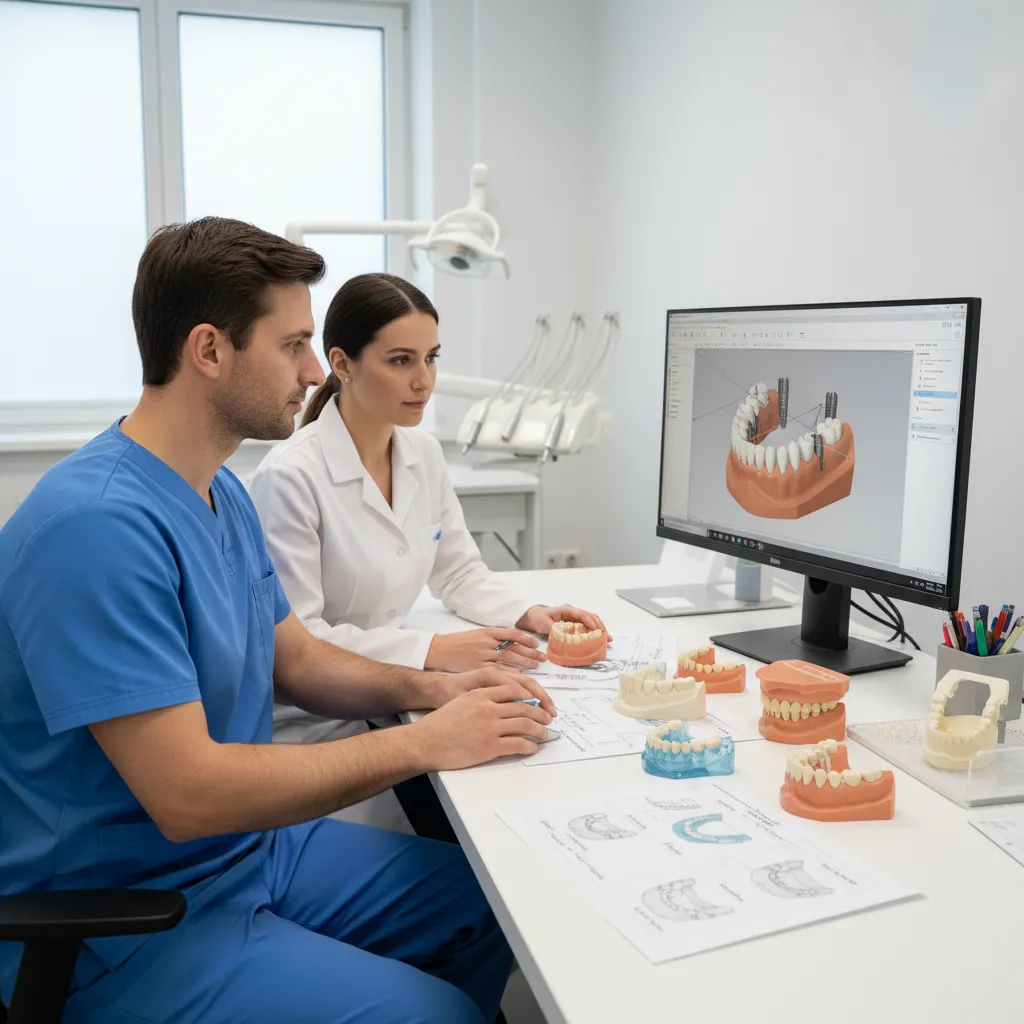
A clear, shared digital workflow between clinic and lab helps keep multi unit abutment full arch cases predictable from surgery to final prosthesis.
1. Surgical planning (high level)
At NovaDent, we’re not in the business of telling surgeons how to operate, but we do see patterns in the cases that go smoothly:
- A clear restorative plan agreed before implant placement (tooth position, vertical dimension, occlusion)
- Implant positions chosen with restorative space, screw access and cleansability in mind
- A limited, documented set of preferred MUAs per system to reduce decision fatigue on the day
If you share planned implant positions and intended MUAs with us ahead of surgery, we can prepare provisional frameworks, guide designs or at least a concise parts list.
2. Impression or scan: implant vs abutment level
You can work either at implant level or at MUA level:
- Implant level: Useful when you’re unsure about final MUA choice; the lab can virtually place MUAs in software and advise.
- MUA level: Helpful in full arch cases with verified, stable MUAs, giving the lab a standardised platform and sometimes simplifying verification.
Digitally, that means using implant-level or MUA level scan bodies compatible with your system. Our digital dentistry lab partner guide covers both approaches; choose one and document it across your team to reduce mix ups.
3. Provisional to final: keeping it predictable
A typical pathway for an All on 4 style case might look like:
- Day of surgery: place implants, torque to manufacturer recommendations, place MUAs, convert denture to an immediate screw retained provisional on temporary cylinders.
- Healing phase: monitor tissue response; adjust the provisional for occlusion and hygiene.
- Definitive phase: take an accurate MUA level impression/scan, fabricate a verification jig, then design and mill the final framework and bridge.
Long term cohort studies of All on 4 type cases have reported high implant survival rates over more than a decade, often in the mid 90% range at 10–18 years when protocols are followed carefully. All on 4 long term outcomes Your own surgical judgment, patient factors and adherence to manufacturer instructions remain the foundation.
Common Pitfalls & How a Good Lab Helps
Mismatched cuff heights across the arch
Random cuff height selection can create a “rollercoaster” prosthetic platform that is tough to restore and harder for patients to clean. Where possible, select a consistent height for adjacent MUAs and adjust soft tissue or prosthesis contour, rather than jumping between extremes.
We often help clinicians by mapping proposed cuff heights to the soft tissue profile on the model or scan and suggesting adjustments before components are ordered.
Unfavourable screw channel emergence
There are few things more frustrating than a beautifully milled bridge with a screw channel right through the incisal edge of a central incisor. Early digital planning with restorative driven implant placement, plus considered use of angulated MUAs, prevents this. If we see a planned trajectory that looks awkward, we’ll flag it with you before framework design.
Digital files and scan bodies not matching
A frequent issue is scan bodies that don’t match the selected MUAs or implant line. That leads to guesswork, delays or remakes. To reduce this risk, we provide our referring practices with a simple intraoral scanner connection guide listing compatible scan bodies and minimum capture requirements for each system.
How NovaDent Labs Supports Your MUA Cases
Because we live in the implant world every day, we see the full spread of MUA scenarios from straightforward two unit bridges to complex All on 4 rehabilitations and our goal is to make them feel repeatable rather than heroic.
- Pre-case review: Optional review of scans, photos and wax-ups, with suggested MUA heights and angulations.
- Framework design: CAD frameworks, verification jigs and provisionals tailored to your preferred systems and materials.
- Implant restorations and QA: ISO- and TGA-aligned workflows for short span and full arch work, with results illustrated on our implant restorations page.
If you’re reviewing your All on 4 or full arch protocol, we’re happy to act as a thought partner. You can request for prices by contacting us for prices.
FAQs
What is the difference between an implant multi unit abutment and a conventional abutment?
A conventional abutment is usually geared toward single crowns or short bridges and may be cement retained. A multi unit abutment is designed as a platform for screw retained prostheses, especially full arch frameworks, and standardises the prosthetic interface across multiple implants.
When should I choose an All on 4 multi unit abutment rather than restoring directly on implants?
In most full arch protocols that use four implants, MUAs are recommended on each fixture to manage angulation, support a passive one piece framework and simplify retrievability. Some systems allow direct implant frameworks, but you lose some flexibility for future maintenance, so review the manufacturer’s guidelines and discuss with your lab for each system you use.
Are MUAs always necessary?
No. In some single tooth or very short span cases with parallel implants and favourable tissue, a standard screw retained restoration directly on the implant may be sufficient. MUAs really shine where you need angulation correction, a unified prosthetic platform or easier long term maintenance.
Related Posts
You may also be interested in

How to Find a Premium Dental Lab

Dental Implant Care: The Tooth May Be Artificial, But the Care Is Real
TMJ Splint vs Night Guard: What’s the Difference?

NovaDent Has Arrived.
Previously VTS Dental Labs.
Same team
Same standards
New identity
Visit our new website