
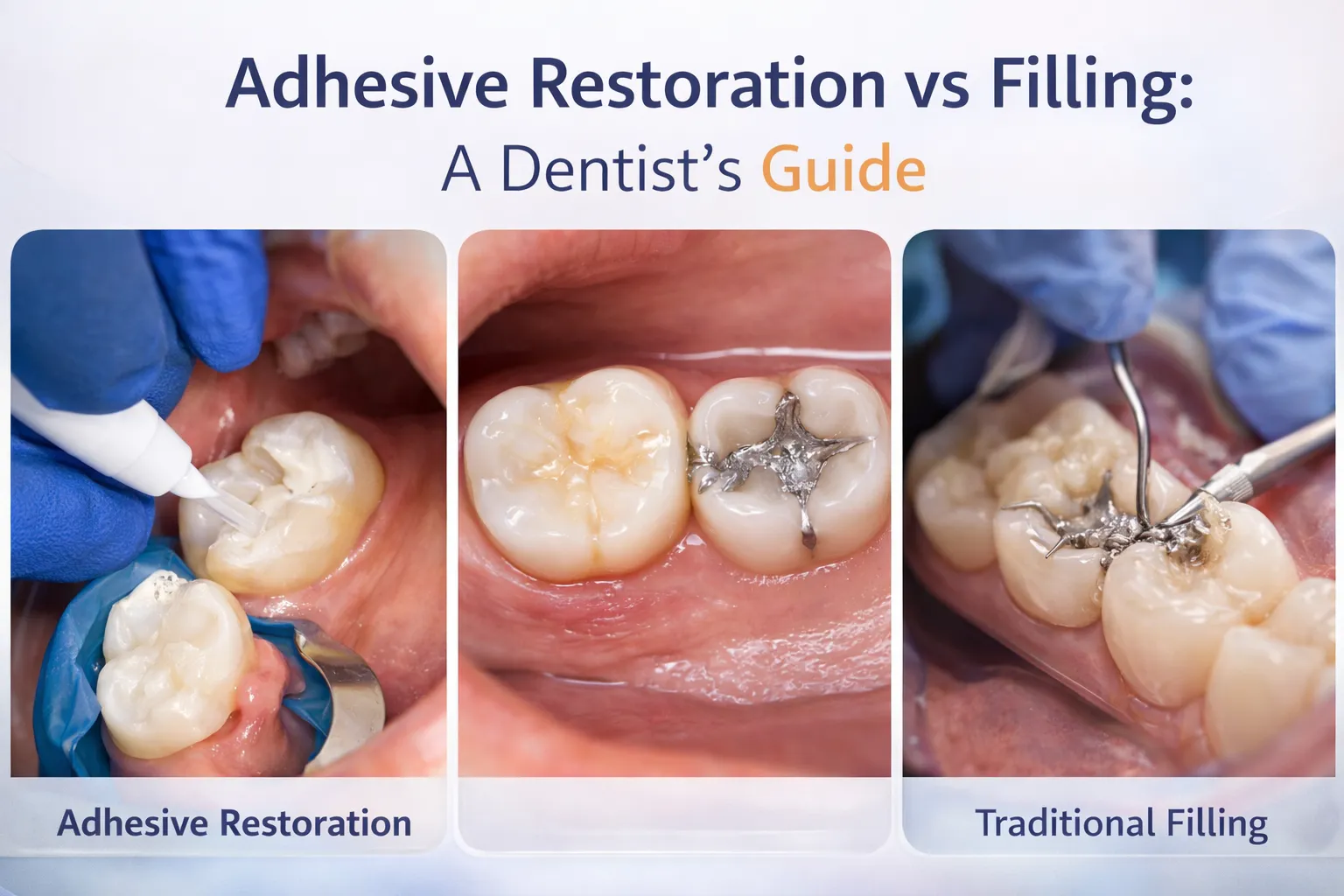
Mid afternoon in the clinic, you’re staring at yet another cracked upper molar. There’s enough tooth left that a full crown feels like overkill, but a simple composite filling might not hold up. Somewhere between the two sits the adhesive restoration and that grey zone is where planning gets tricky.
When dentists search for “adhesive restoration vs filling”, they’re really asking whether it’s still a straightforward direct restoration or whether the case has crossed into partial coverage territory that needs a different prep design, material choice and possibly a lab partner. This guide unpacks how these concepts differ and how to choose a conservative yet durable option tooth by tooth.
TL;DR
- “Filling” is a broad, mostly lay term for a direct restoration placed chairside to treat caries or minor defects.
- “Adhesive restoration” refers to a restoration that relies on micromechanical and/or chemical bonding to tooth structure (enamel and/or dentine) rather than purely mechanical retention.
- In the Australian Schedule, “adhesive restoration direct” is a material group that includes composite resin, glass ionomer cement, and compomers.
- Clinically, the decision point is: Will a bonded restoration with or without cuspal coverage provide predictable function and longevity, or is a simple occlusal/occlusal proximal filling enough?
In other words, every adhesive restoration is a filling, but not every filling makes full use of adhesive dentistry principles. The more the tooth is compromised, the more it pays to think beyond “just another composite” and plan a structured adhesive design sometimes in partnership with your lab for an onlay or partial crown.
2. Definitions: what counts as an adhesive restoration?
Adhesive dentistry focuses on bonding restorative materials to enamel and dentine using adhesives and conditioning protocols. Modern systems create micromechanical retention via etching or functional monomers, and chemical interaction with hydroxyapatite or collagen, achieving clinically useful bond strengths to enamel and dentine as outlined in standard principles of bonding.
The Australian Schedule groups “adhesive restoration direct” as a generic material category that covers:
- Composite resin
- Glass ionomer cement (GIC)
- Compomers and resin modified GICs
In day to day usage, many clinicians use “adhesive restoration” to describe:
- Direct resin composite restorations with bonding systems
- Cuspal coverage buildups (e.g., endo treated posterior teeth)
- Indirect bonded restorations such as onlays, overlays, and partial coverage ceramic crowns
At NovaDent, that last group often involves CAD/CAM ceramic onlays and partial crowns bonded with resin cement a different planning conversation from a one surface occlusal composite.
3. When it’s “just” a filling
“Filling” is the umbrella term patients understand. On the schedule, you’re usually thinking along the lines of direct restorations with composite, amalgam, GIC or similar materials.
Typical scenarios suited to a straightforward filling
- Small Class I and simple Class II lesions with thick remaining marginal ridges
- Non load bearing anterior Class III restorations
- Small non carious cervical lesions where a conservative GIC or resin approach will suffice
- Existing restoration replacement with good remaining tooth structure and low crack risk
In many of these cases, a bonded composite or GIC is technically an adhesive filling, but the overall risk profile is low. You’re not relying on extensive cuspal coverage or complex occlusal design; you just need a well placed, well bonded material with adequate isolation and occlusal adjustment.
For such teeth, your clinical priority is often efficiency and moisture control. If you’re scanning, these are rarely the cases that reach your lab unless they’re part of a wider restorative plan or staged workup using a digital workflow.
4. When to plan an adhesive restoration instead
The conversation shifts once structure is compromised.
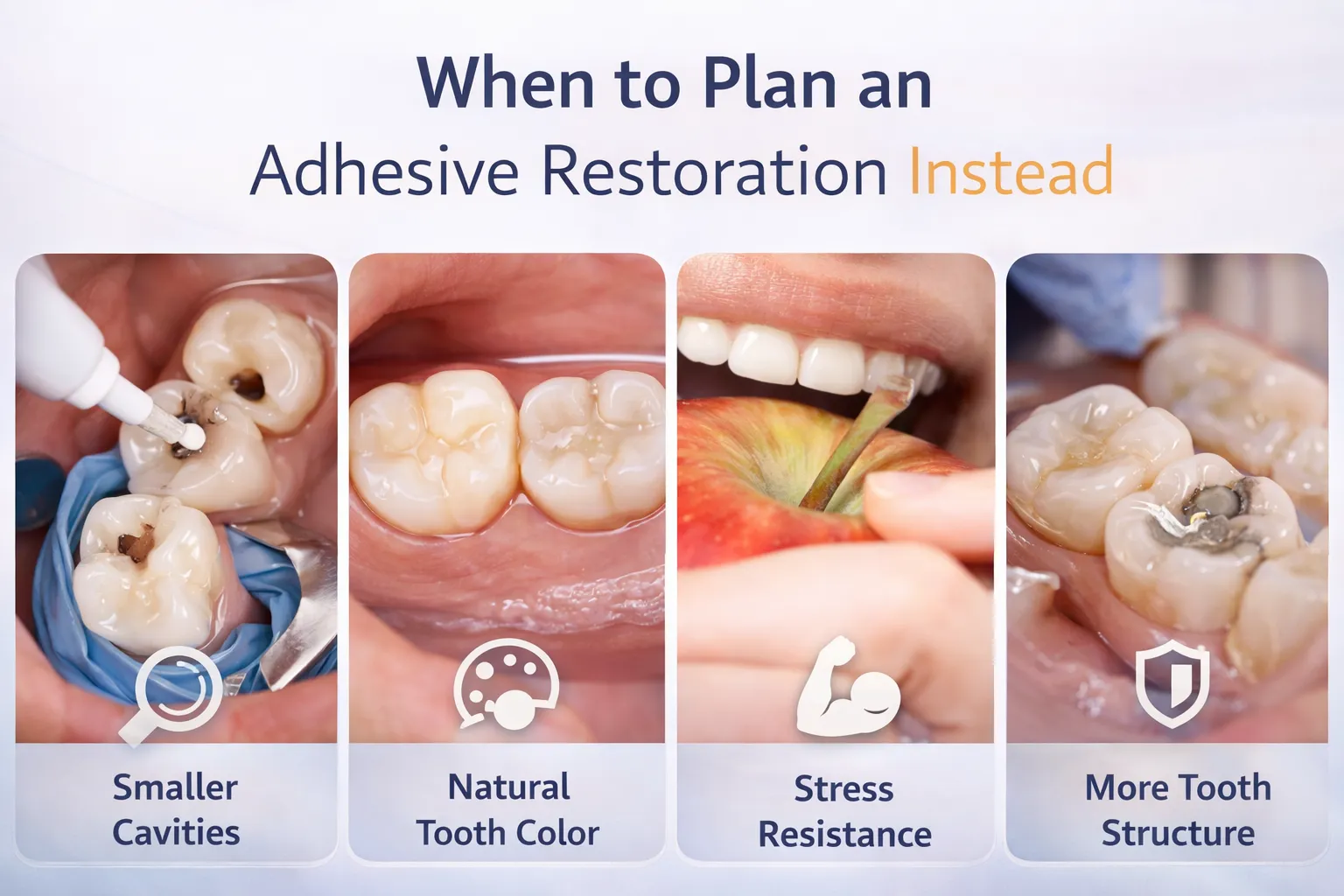
“At some point, increasing the size of a direct filling without rethinking the design becomes a false economy.”
Red flags that push you toward an adhesive restoration concept
- Loss of one or more cusps or very thin remaining ridges
- Root canal treated posterior teeth needing reinforcement
- High occlusal load (bruxism, heavy contacts, group function on compromised teeth)
- Cracked tooth symptoms around large existing restorations
- Extensive MOD or MODL/MODBL restorations where fracture risk is high
In these situations, thinking in terms of an adhesive restoration helps you plan:
- How much cuspal coverage you want
- Whether a direct composite onlay style build up makes sense, or whether to send the case to the lab for an indirect onlay or overlay
- What bonding protocol and resin cement system you’ll use
Case vignette: large MOD vs bonded onlay
A 47 year old patient presented with intermittent pain on biting on a lower first molar restored with a large MOD amalgam. The mesio lingual cusp was undermined, the marginal ridges showed craze lines, and the patient reported nighttime clenching. Radiographs showed an endodontically treated tooth with very limited sound peri cervical dentine supporting the cusps.
Rather than simply replacing the amalgam with a larger composite, the clinician prepared the tooth for a bonded lithium disilicate onlay and referred the case to the lab. At the 18 month review, the tooth was asymptomatic, the onlay margins were intact, and there were no new fracture lines illustrating how moving from “bigger filling” to “adhesive restoration” thinking can change long term prognosis.
Adhesive restorations, particularly indirect bonded ceramics let you conserve sound tissue compared with full crowns, while still redistributing stress more favourably than a big boxy filling. For fracture prone molars, that can make the difference between many years of service and an early crack extending subcrestally.
5. Materials, bonding systems, and prep design
Once you start thinking of “adhesive restoration” rather than “bigger filling”, three elements link up: the material, the bonding system, and the configuration of your prep.
Common adhesive materials
- Resin composite – direct or indirect; versatile, aesthetic, highly technique sensitive.
- Glass ionomer & resin-modified GIC – useful where isolation is compromised, for cervical lesions, or as bases/cores.
- Indirect ceramics (e.g., lithium disilicate, hybrid ceramics) – typically lab-fabricated and bonded with resin cements, ideal for partial coverage onlays and overlays.
From a materials perspective, composite and ceramic bonded restorations are where NovaDent most often partners with clinicians. Our fixed prosthetics range includes lithium disilicate onlays and zirconia ceramic hybrids designed with sufficient thickness, rounded internal line angles, and emergence profiles that match your prep strategy.
Bonding and surface treatment
- Tooth side: total etch or selective etch on enamel, self etch or universal adhesive on dentine, scrupulous isolation, and attention to adhesive film thickness.
- Restoration side: HF etching and silanation for glass ceramics, air abrasion and appropriate primers for zirconia and some hybrids.
Prep design for bonded restorations typically favours rounded internal line angles, minimal bevels where enamel is present, and enough axial/cuspal thickness for your chosen material. A quick call with your lab about minimal material thickness and connector dimensions can save chairside adjustments later; our team routinely reviews digital scans and prep photos for this reason.
6. Chairside comparison: adhesive restoration vs conventional filling
| Feature | Adhesive restoration (bonded) | Conventional filling (mainly mechanical retention) |
|---|---|---|
| Retention mechanism | Micromechanical/chemical bond to enamel and dentine via adhesives and resin cements | Undercuts, grooves and macro retention; limited or no true adhesion (e.g., amalgam) |
| Tooth conservation | Can preserve cusps and peri-cervical dentine with partial coverage | Often requires more removal of healthy tooth to create mechanical lock |
| Stress distribution | Better redistribution when cusps are covered and bonded as a unit | Higher stress at margins and remaining cusps in large MOD amalgams/composites |
| Typical indications | Heavily restored teeth, endo treated teeth, fracture risk, high load cases | Small to moderate lesions, low risk of cusp fracture |
| Lab involvement | Often for indirect ceramic/composite onlays and overlays | Usually chairside only |
7. Explaining adhesive fillings to patients
Clinically, you’re weighing bond strength, occlusal forces, and remaining tooth structure. Patients, though, mostly hear “filling”, “onlay”, or “crown”. A short, plain‑language explanation goes a long way.
Chairside script (adapt as you like)
“This tooth has lost quite a bit of support. Instead of just another filling, I’d like to place a bonded restoration that can wrap and reinforce the tooth. It still lets us keep more of your natural tooth than a full crown, but it’s stronger than a small filling on its own.”
You can add that the restoration is designed digitally and made by a lab for a precise fit if you’re planning an indirect option. Linking that explanation to images or a model of an onlay vs a filling helps patients understand this option, not sold.
8. Where your lab fits in: indirect adhesive restorations
Many of the grey-zone teeth that feel “too big for a filling, not quite a crown” are ideal for indirect adhesive restorations. This is where a lab with both digital and clinical insight can shoulder some of the planning load.
Common NovaDent cases in this category
- Posterior onlays and overlays on endodontically treated teeth
- Partial coverage ceramic restorations replacing failing MOD composites or amalgams
- Bonded build ups under full crowns where an implants solution is being staged
With compatible intraoral scanner files and digital scans, we can work from your pre-op photos and occlusal notes to propose material choices and designs that align with your adhesive protocol. Our ISO 13485 and TGA aligned processes support consistent fits and predictable bonding surfaces.
If you’re often hesitating between a large direct composite and an onlay, sharing a few representative cases with our team can help establish a shared threshold so future “adhesive restoration vs filling” decisions become quicker and more consistent across your practice.
Visit our For Dentists page to request the current price list and see our case submission checklist.
FAQs
Is an adhesive filling the same as a composite filling?
In most clinics, yes: when you place a resin composite with a bonding system, you are placing an adhesive filling. Composite relies on bonding to enamel and dentine rather than just mechanical undercuts, which distinguishes it from traditional amalgam.
When would you choose an adhesive restoration instead of a standard filling?
Any time the tooth is significantly weakened lost cusps, endodontic access, large MODs, high occlusal load it is worth planning an adhesive restoration that reinforces cusps, either as a carefully designed direct composite or a bonded indirect onlay/overlay. Large, flat‑topped composites in fragile molars tend to come back as cracked tooth emergencies.
Do adhesive restorations last as long as conventional fillings?
Longevity depends on case selection, operator technique, material choice, and patient factors. A review of posterior composite restorations reported annual failure rates of roughly 1 to 3% and about 90% survival at 10 years, similar to amalgam in many studies when good adhesive protocols are used. In a long term study of bonded ceramic inlays and onlays, about 93% of restorations were still functioning after around 11 years in service. Bonded ceramics, when properly designed and cemented, can perform very well over the long term, particularly where occlusal loading is managed thoughtfully.
Does this affect how I itemise treatment?
The Australian Schedule classifies materials and surfaces, not just technique, and it’s worth cross checking the current ADA schedule handbook or your fund guidance when you’re unsure. When in doubt, document your clinical reasoning (fracture lines, occlusal scheme, endodontic status) clearly in your notes. That same information also helps your lab support you more effectively. To see similar scenarios, you can browse our blog restorative cases for more context.
Related Posts
You may also be interested in

How to Find a Premium Dental Lab

Dental Implant Care: The Tooth May Be Artificial, But the Care Is Real
TMJ Splint vs Night Guard: What’s the Difference?

NovaDent Has Arrived.
Previously VTS Dental Labs.
Same team
Same standards
New identity
Visit our new website