%2520(1).jpeg)
.webp)
Patients in Australian surgeries regularly ask, “how long do dental implants last?” They’re comparing implants with bridges or dentures and want to know whether the surgery, healing time, and fee will pay off in the long run. As their clinician, you need an answer that’s honest and evidence based, not a marketing slogan. This guide distills current evidence on implant and prosthesis lifespans, common failure patterns, and maintenance protocols for both single tooth and full arch cases. For more clinically focused reading on related topics, you can browse our implant blogs.

Clear, evidence based conversations help patients understand the long term expectations for dental implants.
TL;DR:
- Most modern implants show 10 year survival in the mid 90s percent range in well maintained patients.
- The fixture often outlasts the prosthesis: implant supported crowns and bridges commonly need repair or replacement after roughly 10–15 years, depending on material and loading.
- All on 4 style full arch cases report implant survival around the mid 90s percent range at 10 years in suitable patients, but prosthetic maintenance (chips, fractures, wear) is common.
- Mini implants can work well in selected cases but typically show slightly lower survival and more complications than standard diameter implants under heavy function.
- Key threats: peri implantitis, uncontrolled plaque, smoking, uncontrolled diabetes, bruxism, and compromised prosthetic design (for example, long cantilevers or poor cleansability).
- Consistent maintenance and thoughtful lab design are the levers you control to keep implants functioning for the long haul.
What “lifespan” really means for implants
When a patient says “implant”, they usually mean the whole unit: fixture, abutment and crown or bridge. Clinically, each of those components has its own timeline and failure patterns.
- Fixture (implant body): titanium or zirconia anchored in bone. When osseointegration is stable and the site stays healthy, fixtures can function for many decades.
- Superstructure: abutments, screws, bars, multi unit abutments, and frameworks.
- Prosthesis: single crowns, short spans, or full arch bridges in porcelain fused to metal, monolithic zirconia, or acrylic on metal.

Separating the fixture, components, and prosthesis helps frame realistic lifespan expectations for each part of a dental implant restoration.
Long term studies and meta analyses on modern, screw shaped root form implants commonly report 10 year survival in roughly the 94–98% range in appropriately maintained patients. That survival definition usually means the fixture is still present and in function, even if minor complications have been managed along the way.
By contrast, crowns and full arch prostheses are more “consumable”. Veneering ceramics chip, acrylic teeth wear, screws loosen, and occlusion drifts. Replacement or major refurbishment on an approximately 8–15 year cycle is common, especially in high force cases.
Professional bodies generally advise that well cared for implants can last many years, potentially life long, while making it clear there is no lifetime guarantee. That balanced message is usually the most defensible way to frame expectations with patients.
If you’d like a patient friendly explainer you can share chairside, the Oral Health Foundation has a concise overview of dental implants and their care.
How long do full dental implants last in practice?
When colleagues ask “how long do full dental implants last?”, they’re often thinking about single units and short spans in partially dentate patients. From a lab perspective, the answer still starts with separating the fixture from the restoration.
Typical timelines for single and short-span restorations
| Component | Typical clinical picture* |
|---|---|
| Implant fixture (non smoker, good hygiene) | 10‑year survival commonly in the mid 90s% range in healthy, well maintained patients. |
| Single crown on implant | Roughly 10–15 years is a reasonable expectation before esthetic or mechanical replacement, especially for veneered ceramics. |
| Short span fixed bridge (2–4 units) | Similar to single crowns for fixture survival, with a higher rate of screw and ceramic events, particularly in posterior segments. |
*Ranges, not promises; individual outcomes depend on patient factors, surgical quality, prosthetic design, material selection, and maintenance.
For your own cases, the biggest levers you control once surgery has healed are occlusal design and cleansability. A considered emergence profile and contact pattern, plus maintenance friendly contours, often do more for 20 year function than any headline success rate.
At NovaDent we routinely discuss these details case by case with referrers, particularly for posterior units in bruxers. If you’d like our team to review an upcoming case, you can explore our implant restoration options, send digital files directly from your scanner, and review our turnaround times when scheduling.
How long do All on 4 dental implants last?
For completely edentulous jaws, full arch immediate load protocols such as All on 4 have reshaped expectations for function and comfort. The question for many dentists is not whether to offer full arch implants, but how long All on 4 style cases can be expected to last.
Long term studies on All on 4 concepts typically report implant survival around 95–98% at 10 years in suitable patients treated by experienced teams. The fixtures themselves tend to perform very well; the main burden over time lies with prosthetic repairs.

Full arch, implant supported prostheses such as All on 4 can deliver long term function when case selection and maintenance are carefully managed.
Fixture vs prosthesis in All on 4 cases
- Implants: high survival at 10+ years when bone volume, loading protocol, and hygiene are favourable.
- Acrylic on metal bridges: excellent initial shock absorption, but tooth wear, fractures, and staining often lead to refurbishment or replacement in roughly a decade.
- Monolithic zirconia frameworks: greater wear resistance and stain resistance, but more technique sensitive in terms of design and occlusion; when well executed, many teams anticipate longer prosthetic service lives.
Access for hygiene, a stable vertical dimension, and precise passive fit are central here. Full arch complications often stem from micromovement at the interface, excess ca ntilever, or bulky, plaque retentive contours.
If you regularly restore full arches, it helps to standardise your workflow with a lab partner that has a dedicated full arch implant support team and clear restorative roadmaps for All on 4 and related concepts.
How long do mini dental implants last?
Mini implants (small diameter implants below roughly 3 mm) have opened options for patients with limited bone or finances, particularly for stabilising lower dentures. Clinically, their longevity profile is distinct from standard diameter fixtures.
Systematic reviews and clinical series suggest that mini implants can provide useful retention for overdentures, with short to medium term survival often in the mid‑95% range, especially in the mandible and when several fixtures share the load (mini vs standard review; mini implant outcomes). At the same time, their narrower diameter and higher stress per unit area make them more vulnerable under heavy occlusal loading, and many studies report lower survival and more prosthetic events than with standard diameter implants in high force situations.
For that reason, many implant surgeons treat mini implants as a solution for specific scenarios such as narrow ridges or transitional stabilisation rather than a universal substitute for standard fixtures. When planning, it’s worth documenting that discussion explicitly in the notes and consent.
If you’re considering minis for a case with tight anatomy, our technicians are happy to review scans and help you compare mini vs standard diameter designs within your preferred systems.
Risk factors that shorten implant lifespan
Implants rarely “just fail”. Decay is out of the picture, but the same biological themes that trouble natural teeth show up around fixtures as well, often combined with mechanical complications.
Patient and systemic factors
- Poor plaque control and cleansability: persistent biofilm, often worsened by plaque retentive prosthetic contours, drives mucositis and peri implantitis.
- Smoking: large reviews have reported higher failure and complication rates in smokers than in non smokers.
- Uncontrolled diabetes and systemic disease: delayed healing and altered immune response increase biologic risk around both fixtures and prostheses.
- Bruxism and parafunction: repeated overload accelerates screw loosening, ceramic chipping, and bone loss.
Local and mechanical factors
- Compromised primary stability or bone volume: marginal implant positioning, dehiscence, and fenestrations raise the stakes for long term load management.
- Unfavourable occlusion: long cantilevers, canting, and edge to edge contacts concentrate stress on screws and crestal bone.
- Cement retained units without radiographic checks: residual cement remains a common finding in peri implantitis cases.
Prosthetic and lab related factors
- Lack of passive fit in full arch frameworks.
- Material choices that don’t match the patient’s force profile (for example, thin porcelain veneers on a heavy bruxer).
Many of these factors are controllable with thoughtful case selection, clear communication with your lab, and a straightforward long term review protocol.
For clinicians who want more detailed risk assessment tools, summary tables in larger implant reviews are a handy starting point, alongside primary papers and guidelines in your own region.
Maintenance protocols that help implants last decades
Once the prosthesis is fitted, the lifespan of the case depends heavily on what happens in the hygiene room and at periodic reviews. Many long term failures are late stage discoveries of problems that began quietly years earlier.
For your clinical team
- Recall and imaging: 6–12‑monthly reviews for stable patients (shorter intervals for smokers, diabetics, and periodontitis history), with baseline and periodic periapicals to track crestal bone and pick up early peri implant changes.
- Occlusal monitoring: recheck contacts at each review, especially after orthodontic movement or major restorative work elsewhere in the arch.
- Instrumentation and charting: use implant‑safe instruments and polishing pastes; record any suppuration, bleeding, or pocketing in a dedicated implant chart.
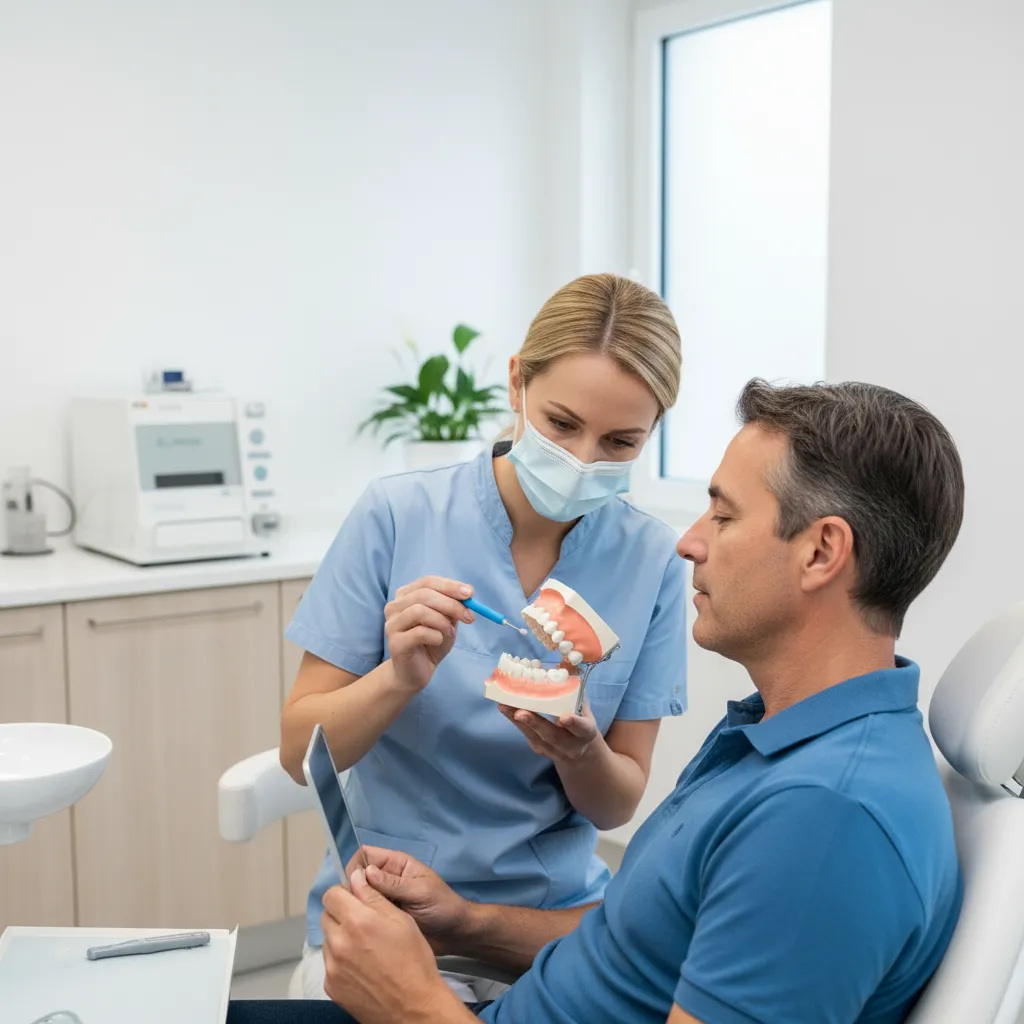
Structured maintenance visits and home care coaching are critical for extending the lifespan of dental implants and their restorations.
Long term cohort and meta‑analytic data show that many fixtures remain in function for 15–20+ years when peri‑implant tissues stay healthy, whereas crowns and bridges on those fixtures often need one or two replacements over that period as materials wear or fracture.
For patients (simple talking points)
- “Clean it like a tooth, but with even more care” interdental brushes, floss aids, or water flossers as appropriate.
- Night guards for bruxers, with periodic checks and relining or replacement as materials fatigue.
- Prompt reporting of any mobility, clicking, or change in bite.
Many practices in Australia now include a brief “implant service plan” in their consent process, outlining expected review intervals, likely refurbishment timelines for prostheses, and fees for common maintenance items. That document can save difficult conversations a decade later.
If you’re standardising these protocols, it helps to align them with your digital workflows, sharing STL files and photos with your lab through secure digital case submission and keeping key records in one place.
How NovaDent Labs supports long-term implant success
For us, long term implant success starts with restorations that are cleanable, biomechanically sensible, and compatible with your digital workflows. Our clinicians and technicians plan cases with you so the fixture, abutment, and prosthesis support each other over the life of the case.
- Emergence and cleansability: CAD/CAM design that shapes emergence profiles and embrasures so patients and hygienists can access critical surfaces.
- Occlusion and force control: attention to occlusal schemes, contacts, and cantilever limits for single units and full arch implant restorations.
- Material selection: guidance on when to choose acrylic hybrids, metal ceramic, or zirconia configurations to match parafunction risk and aesthetic goals.
- Documentation for maintenance: digital records of designs and components so prostheses can be repaired or remade predictably years later.
If you’d like to shape a consistent protocol for implant restorations in your practice, you can request our price list or contact NovaDent Labs to discuss your current implant systems, digital setup, and full arch volume.
FAQs
Can dental implants last a lifetime?
They can, and many do, especially in healthy, non smoking patients with excellent home care and regular reviews. A fair message is: “With healthy gums, good home care, and regular check ups, implants often last for decades, and some last for life, but nothing in biology is guaranteed”.
How long do All on 4 dental implants last compared with traditional full arch cases?
In well selected patients, All on 4 style full arch cases show fixture survival broadly comparable to other full arch implant approaches, commonly in the mid 90s percent range at 10 years. The main difference is prosthetic maintenance: acrylic teeth on metal frameworks usually need refurbishment or replacement after roughly a decade, while well designed zirconia frameworks can often stretch longer when occlusion and hygiene are well controlled.
How long do mini dental implants last?
Mini implants can be a helpful tool for denture stabilisation or tight ridges, but they typically carry a shorter expected lifespan under heavy loads. Systematic reviews suggest respectable short to medium term survival, especially for mandibular overdentures, yet often slightly lower survival and more complications than standard diameter implants when forces are high. Many clinicians counsel that minis are best reserved for specific indications and explain that standard diameter implants usually offer a longer working life where anatomy allows.
When should I recommend replacing an implant crown or full arch bridge?
Replacement is usually driven by function and hygiene, not an arbitrary age. Common triggers include fractured porcelain or acrylic, recurrent prosthetic complications, contour that no longer suits soft tissue changes, or esthetics that no longer meet the patient’s expectations.
Related Posts
You may also be interested in
.png)
How to Find a Premium Dental Lab

Dental Implant Care: The Tooth May Be Artificial, But the Care Is Real
TMJ Splint vs Night Guard: What’s the Difference?

NovaDent Has Arrived.
Previously VTS Dental Labs.
Same team
Same standards
New identity
Visit our new website